Why NCERT for UPSC and Other State Service Exams?

Build your Foundation Right for UPSC | Prepare for UPSC at Right Time & Right Age

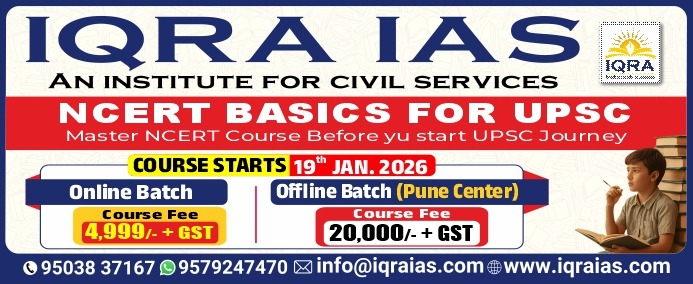
Exclusive Programme by IQRA IAS. Register Today at Discounted Fee Offers!

Online & Offline Classes

Why NCERT for UPSC?

  • NCERT = The Conceptual Backbone of UPSC Prep
  • UPSC Directly Asks NCERT-Based Questions Every Year
  • Removes Confusion from Multiple Sources
  • Recommended by Toppers Consistently
  • Helps Interlink GS Subjects Effectively

By the End of This Module, Aspirants Will:

  • Strengthen core NCERT-based fundamentals across History, Geography, Polity, Economy, Society & Environment.
  • Link foundational concepts with GS syllabus requirements, enabling better understanding of GS I, GS II, GS III & Essay.
  • Connect NCERT themes with governance, policy issues, and national developments, improving analytical depth.
  • Apply concepts effectively to Current Affairs, enhancing answer-writing quality and issue-based thinking.
  • Build a strong, integrated foundation essential for advanced preparation and a high-scoring UPSC attempt.

Watch NCERT Demo Lectures

Batch Details

Online Batch Start DateRegular FeeDiscounted FeeRegister Now
NCERT Basics for UPSC (Online, Recorded)Ongoing7,500 /- + GST 3999/- + GSTRegister Now
NCERT Basics for UPSC Online (Live & Recorded)19th January 20267,500 /- + GST 4,999/- + GSTRegister Now

Additional 18% GST applicable on above fee


Offline Batch Start DateRegular FeeDiscounted FeeRegister Now
NCERT Basics for UPSC (Offline, Classroom Pune)19th January 202625,000 /- + GST 20,000/- + GSTRegister Now

Additional 18% GST applicable on above fee

Course Overview:

  1. Course Duration: 6 to 8 Months
  2. In-depth preparation for each topic included in the course.
  3. Approximately 300+ hours of 100+ classes.
  4. Syllabus starts from the fundamental level.
  5. Full Academic Support & hand holding by IQRA IAS mentors and faculty
  6. For offline aspirants, facility to watch classes online
  7. Complete Coverage of Syllabus
  8. Other Free Facilities:
    1. Current Affairs Classes & Study Material
    2. Editorials
    3. Free Weekly Current Affairs Tests

Why NCERT for UPSC at IQRA IAS?

NCERT Batch Features

Experienced UPSC faculty simplify NCERT concepts and offer continuous academic & strategic guidance.

A systematic schedule covering NCERT 6–10 thoroughly, with selective 11–12 topics for deeper conceptual grounding.

Attend Offline OR Online with full flexibility.
🎥 Recorded lectures available for revision anytime.

Every session includes:

A specific NCERT chapter/theme

UPSC linkage

Concept reinforcement

Prelims + Mains angle

✓ MCQs

✓ Short Notes

✓ Chapter Tests

All mapped to NCERT chapters for consistent evaluation.
NCERT-based learning strengthens History, Polity, Geography, Economy, Environment & Science foundations.

Dedicated faculty & mentors assist with academic queries to ensure zero conceptual gaps.

NCERT MODULE PLAN

Module 1 Ancient India

Sources of History
Indus Valley Civiization
Vedic Age and Mahajanpadas
Mauryan Empire

Module 2

Post Mauryan
Gupta Empire

Module 3 Medieval India

Early Medieval India
Delhi Sultanate
Mughal Empire
Vijaynagar Empire
Bhaktism and Sufism

Module 4 Modern India

18th Century Political Formations
Advent of Europeans
The company Rule
Rebeles and The Raj
Mahatma Gandhi and Nationalist ovement

Module 1 Introduction to Economy; Growth vs Development

The Story of Village Palampur, People as Resource
Development

Module 2 Indian Economy Phase I (1947-1990); Five Year Plans

INDIAN ECONOMY ON THE EVE OF INDEPENDENCE – LOW LEVEL OF ECONOMIC DEVELOPMENT UNDER THE COLONIAL RULE,
AGRICULTURAL SECTOR, INDUSTRIAL SECTOR, FOREIGN TRADE, DEMOGRAPHIC CONDITION, OCCUPATIONAL STRUCTURE, INFRASTRUCTURE

INDIAN ECONOMY 1950-1990 16
– THE GOALS OF FIVE YEAR PLANS, AGRICULTURE, INDUSTRY AND TRADE, TRADE POLICY: IMPORT SUBSTITUTION”

Module 3 Indian Economy Phase II: LPG Reforms

LIBERALISATION, PRIVATISATION AND GLOBALISATION :
AN APPRAISAL, BACKGROUND, LIBERALISATION, PRIVATISATION, GLOBALISATION, INDIAN ECONOMY DURING REFORMS: AN ASSESSMENT

GLOBALISATION AND THE INDIAN ECONOMY

Module 4 Human Capital; Employment and Poverty; Rural Development

Poverty as a Challenge, Food Security in India

Poverty – WHO ARE THE POOR, HOW ARE POOR PEOPLE IDENTIFIED?, THE NUMBER OF POOR IN INDIA, WHAT CAUSES POVERTY, POLICIES AND PROGRAMMES TOWARDS POVERTY ALLEVIATION
RURAL DEVELOPMENT: WHAT IS RURAL DEVELOPMENT?, CREDIT AND MARKETING IN RURAL AREAS, AGRICULTURAL MARKET SYSTEM, DIVERSIFICATION INTO PRODUCTIVE ACTIVITIES, SUSTAINABLE DEVELOPMENT AND ORGANIC FARMING
HUMAN CAPITAL FORMATION IN INDIA
EMPLOYMENT: GROWTH, INFORMALISATION AND OTHER ISSUES

Module 5 Basics of Indian Economy

Introduction to Economy, Theory of consumer behaviour

SECTORS OF THE INDIAN ECONOMY

Module 6 Money and Banking

Money and Credit

Money and Banking – Functions of money, Demands of moneym, Supply of money.

Module 7 Fiscal Policy and Budget

The Government: Functions and Scope, Components of the Government Budget, Fiscal Policy.

Module 8 Balance of Payment

The Balance of Payment, BoP Surplus and Deficit, The foreign exchange market, The determination of income in an open economy, Trade deficits, savings and investments

Module 1 Introduction to Indian Social, Cultural Political Values

Understanding Diversity, Diversity and Discrimination, Urban Administration, Rural Livelihoods
How the State Government Works
Democracy and Diversity

Module 2 Democracy

DEMOCRACY IN THE CONTEMPORARY WORLD
Popular Struggles and Movements

Module 3 Constitution

The Indian Constitution
What is Democracy? Why Democracy?
Constitution: Why and How?, Constitution as a Living document, The Philosophy of the constitution

Module 4 Rights and Citizenship

Rights, Citizenship
Working of Institutions

Module 5 Organs of Government

What is Government?
Why do we need a Parliament?, Understanding Laws
Executive, Legislative, Judiciary

Module 6 Federalism

Power sharing, Federalism
Federalism

Module 7 Local Self Government

Key Elements of a Democratic Government, Panchayati Raj, Ruaral Administration

Module 8 Elections

Constitutional Design
Gender, Religion and Caste
Local Governments

Module 9 Governance and Social Aspects

Judiciary,
Understanding Our Criminal Justice System
Freedom, Equality, Social Justice,
Nationalism, Secularism

Module 1 Earth

The Earth in the Solar system, GLOBE : Latitudes and Longitudes, Motions of the earth, Maps, Major Domains of the Earth
Inside Our Earth, Our Changing Earth
The origin and evolution of earth, Interior of the earth, Distribution of Oceans and Continents

Module 2 Geomorphology

India – Climate, Vegetation and Wild Life
Climate, Natural Vegetation and Wild Life
Natural Vegetation, Soils

Module 3 Climatology

Air
Composition and structure of atmosphere, Solar radiation, Heat balance & Temperature, Atmospheric circulation and weather systems, Water in the atmosphere, World climate and climate change.

Module 4 Oceanography

Water
World climate and climate change, Water (Oceans)

Module 5 (Indian Geog): Physiography

Major Landforms of the Earth
India – Size & Location, Physical features of India
India – Location, Structure & Physiography

Module 6 (Indian Geog): Drainage and Climate

Drainage, Climate
Drainage system, Climate

Module 7 Soil, Agriculture, Vegetation, Resources and Industries

“Resources, Land, Soil, Water, Natural Vegetation
and Wildlife Resources, Mineral & Power Resources, Agriculture”
Natural vegetaion & Wild life
Resources & Develotment, Forest & Wild resources, Water resources, Agriculture, Minerals and Energy resources, Manufacturing Industries
Natural vegetaion
Human Development, Human Settlements, Land Resources and Agriculture

Module 8 Human Geography

Population : Distribution, Density, Growth and Composition, Migration : Types, Causes and Consequences, Mineral and Energy Resources, Manufacturing Industries.
The World Population Distribution, Density and Growth, Population Composition, Human Development, Primary & Secondary Activitiesm, Tertiary and Quaternary Activities, Transport and Communication

Module 1 Society: Introduction to Key Concepts and Dimensions

SOCIOLOGY AND SOCIETY, TERMS, CONCEPTS AND THEIR USE IN SOCIOLOGY

Module 2 Social Institutions

UNDERSTANDING SOCIAL INSTITUTIONS

Module 3 Social Structure; Socialisation and Change

Social Structure, Stratification & Social Processes in Society, Social Change and Social Order in Rural and Urban Society, Environment and Society
CULTURE AND SOCIALISATION

Module 4 Indian Society: Introduction, Features and Demography

Introduction to Indian Society,
The demographic structure of Indian society.

Module 5 Social Institutions and Challenges of Indian Society

Social Institutions: Continuity and change, The market as a Social Institution, Patterns of social inequality and exclusion, The challenges of cultural diversity.

Module 6 Change in Indian Society; Impact of Globalisation

Structural Change, Cultural Change, The Story of Indian Democracy, Change and Development in Rural Society & Indutrial Society

Module 1

space & Astronomy ( Newton’s law) Gravity,Value of Gravity, wieghtlessness

Module 2

kepler’s laws, orbit, orbital velocity, types of orbit

Module 3

Geo-synchronous, Geo-stationary, sun-synchronous, escape velocity, satellites

Module 4

nuclear S& T, nuclear science, attom no, mass no, isotope, isobar, isotone, nuclear reactor, moderator, heavy water, coolant, controller rods

Module 5

biotechnology, definiyion, old & new biotech, examples, biofertizer, Gmcrops , BT cotton, drugs & vaccines development, gene therapy, stem cell therapy,branches of biotech green biotech, red biotech etc marine biotech, environmental biotech, bioremediation DNA finger printing

Module 6

Recombinant DNA Technology, stemcell therapy gene therapy, molecular, diagnostics cloning, GM rops transgenic animals , bio-ethics, biopiracy, GEA

NCERT Lecture Plan

History – Ancient India | Lecture 1

Understanding the Past & Sources

Core Sub–Topics Covered

  • What is History? How do historians study the past?
  • Archaeological, Literary & Numismatic Sources
History – Ancient India | Lecture 2

The Stone Age & Indus Valley

Core Sub–Topics Covered

  • Paleolithic, Mesolithic, Neolithic Cultures – Key Features & Sites
  • Indus Valley Civilization – Urban Planning, Society, Economy, Religion, Decline
History – Ancient India | Lecture 3

The Vedic Period

Core Sub–Topics Covered

  • Sources: Rigveda and Later Vedic Literature
  • Political Organization, Economy & Social Structure
History – Ancient India | Lecture 4

Rise of New Religious Ideas & Mahajanapadas

Core Sub–Topics Covered

  • Religious Unrest and Socio-Economic Background
  • Jainism, Buddhism & Sixteen Mahajanapadas
History – Medieval India | Lecture 5

The Early Medieval Period

Core Sub–Topics Covered

  • Transition from Ancient to Medieval Period
  • Political Fragmentation, Regional Kingdoms, Feudal Order
History – Medieval India | Lecture 6

The Delhi Sultanate

Core Sub–Topics Covered

  • Establishment of Turkish Rule: Mamluk to Lodi Dynasties
  • Administration, Economy & Cultural Synthesis
History – Medieval India | Lecture 7

The Mughal Empire

Core Sub–Topics Covered

  • Establishment & Expansion under Babur, Humayun, Akbar, Jahangir, Shah Jahan, Aurangzeb
  • Mughal Administration, Art, Culture & Decline
History – Medieval India | Lecture 8

Regional States & Cultural Developments

Core Sub–Topics Covered

  • Rise of Regional Powers – Marathas, Bengal Nawabs, Hyderabad, Mysore
  • Bhakti & Sufi Movements, Regional Art & Literature
History – Modern India | Lecture 9

Advent of Europeans & British Expansion

Core Sub–Topics Covered

  • Decline of Mughal Empire and Rise of European Powers
  • Portuguese, Dutch, French & British Rivalry
  • British Political Expansion in India
History – Modern India | Lecture 10

Socio-Religious Reforms & Revolt of 1857

Core Sub–Topics Covered

  • Reform Movements – Raja Ram Mohan Roy, Dayanand Saraswati, Vivekananda, etc.
  • Revolt of 1857 – Causes, Course & Consequences
History – Modern India | Lecture 11

Rise of Nationalism & Gandhian Era

Core Sub–Topics Covered

  • Formation of Indian National Congress
  • Gandhian Philosophy and Nationalist Movements
History – Modern India | Lecture 12

Towards Independence

Core Sub–Topics Covered

  • Final Phase of Freedom Struggle
  • Indian Independence Movement Culmination
History – Modern India | Lecture 13

Revision & Combined Test

Core Sub–Topics Covered

  • Comprehensive Revision of Entire NCERT-Based History
  • Timeline Review, Thematic Integration & Practice Test
Geography | Lecture 1

The Earth & Solar System

Core Sub–Topics Covered

  • The Universe and the Solar System
  • Shape and Motions of the Earth
  • The Globe: Latitudes and Longitudes
Geography | Lecture 2

Motions of the Earth & Time Calculation

Core Sub–Topics Covered

  • Earth's Movements – Day/Night and Seasonal Cycles
  • Concept of Time Zones and Standard Time (IST)
  • Heat Zones and Earth's Inclination
Geography | Lecture 3

Landforms of the Earth

Core Sub–Topics Covered

  • Internal Structure of the Earth
  • Mountains, Plateaus, and Plains
  • Endogenic and Exogenic Forces
Geography | Lecture 4

Atmosphere and Weather

Core Sub–Topics Covered

  • Layers of the Atmosphere
  • Composition and Temperature Variation
  • Weather and Climate
Geography | Lecture 5

Climate, Monsoon, and Seasons in India

Core Sub–Topics Covered

  • Factors Affecting India's Climate
  • Indian Monsoon Mechanism
  • Seasons and Climatic Variability
Geography | Lecture 6

Water and Ocean Currents

Core Sub–Topics Covered

  • Distribution of Water on Earth
  • Ocean Currents, Tides and Waves
  • Major Oceans of the World, Oceanic Relief features
Geography | Lecture 7

Drainage System of India

Core Sub–Topics Covered

  • River Systems: Himalayan and Peninsular Rivers
  • Major Rivers and Their Tributaries
  • Role of Rivers in Indian Civilization
Geography | Lecture 8

World's Major Vegetation Types

Core Sub–Topics Covered

  • World's Major Vegetation Types
  • Forest and Grassland Ecosystems
  • Human Impact on Vegetation and Wildlife
Geography | Lecture 9

Natural Vegetation, Soil & Wildlife

Core Sub–Topics Covered

  • Soil Formation and Types
  • Vegetation and Wildlife Zones
  • Conservation and Sustainable Management
Geography | Lecture 10

India's Size and Location

Core Sub–Topics Covered

  • India's Size and Location
  • Neighbours and Boundaries
  • Geological Structure of India
Geography | Lecture 11

The Himalayas, Northern Plains, Peninsular Plateau

Core Sub–Topics Covered

  • The Himalayas, Northern Plains, and Peninsular Plateau
  • Coastal Plains and Islands
  • Importance of Physical Divisions
Polity | Lecture 1

Introduction to Political Life & Democracy

Core Sub–Topics Covered

  • What is Government and Why Do We Need It?
  • Forms of Government – Democracy, Monarchy, Dictatorship
  • Role of Citizens in a Democracy
Polity | Lecture 2

Key Democratic Values

Core Sub–Topics Covered

  • Equality and Justice in a Democracy
  • Liberty and Secularism – Meaning, Relevance, and Contemporary Importance
  • Challenges to Democratic Values in India
Polity | Lecture 3

The Constitution – Formation & Philosophy

Core Sub–Topics Covered

  • Making of the Indian Constitution
  • Key Features: Preamble, Federalism, Parliamentary System
  • Vision and Ideals of the Founding Fathers
Polity | Lecture 4

Fundamental Rights & Duties

Core Sub–Topics Covered

  • The Six Fundamental Rights
  • Fundamental Duties and Their Significance
  • Landmark Judicial Judgments Strengthening Rights
Polity | Lecture 5

Directive Principles of State Policy

Core Sub–Topics Covered

  • Concept and Classification of DPSPs
  • Relationship between Fundamental Rights and DPSPs
  • Implementation, Challenges, and Limitations
Polity | Lecture 6

Parliament and the Law-Making Process

Core Sub–Topics Covered

  • Structure and Composition of Parliament
  • Legislative Procedure – Ordinary and Money Bills
  • Powers and Functions of the Speaker and Parliamentary Committees
Polity | Lecture 7

Executive – President, PM & Council

Core Sub–Topics Covered

  • Election, Powers, and Functions of the President
  • Role and Responsibilities of the Prime Minister and Cabinet
  • Relationship between Legislature and Executive
Polity | Lecture 8

Judiciary and Federalism

Core Sub–Topics Covered

  • Structure of the Indian Judiciary
  • Powers of the Supreme Court and High Courts
  • Judicial Review, Independence, and Federal Balance
Polity | Lecture 9

State Governments & Local Bodies

Core Sub–Topics Covered

  • State Legislature and Executive – Structure and Powers
  • Panchayati Raj Institutions
  • Urban Local Governance – Municipalities and Corporations
Polity | Lecture 10

Elections & Political Parties

Core Sub–Topics Covered

  • Election Commission of India
  • Conduct of Free and Fair Elections
  • Role of Political Parties, Pressure Groups, and Electoral Reforms
Polity | Lecture 11

Public Administration & Policy Implementation

Core Sub–Topics Covered

  • Concept and Evolution of Public Administration
  • Role of Bureaucracy and Civil Services in Policy Execution
  • Public Accountability and Governance Ethics
Polity | Lecture 12

Key Constitutional Features Recap

Core Sub–Topics Covered

  • Recap of Key Constitutional Provisions
  • Mock Test covering Rights, Parliament, and Judiciary
  • Linkages of Polity with Contemporary Issues and Governance Reforms
Economy | Lecture 1

Understanding the Indian Economy

Core Sub–Topics Covered

  • What is an Economy? Types – Primary, Secondary, and Tertiary Sectors
  • Economic Activities in Villages
  • Economic Development Indicators – GDP, HDI, PCI
Economy | Lecture 2

Contribution of Agriculture, Industry, and Services

Core Sub–Topics Covered

  • Contribution of Agriculture, Industry, and Services
  • Organized vs Unorganized Sectors
  • Employment Patterns and Sectoral Shifts
Economy | Lecture 3

Agriculture, Industry & Infrastructure

Core Sub–Topics Covered

  • Role of Agriculture in Indian Economy
  • Industrial Growth and the MSME Sector
  • Infrastructure: Power, Transport, Communication
Economy | Lecture 4

External Sector & International Trade

Core Sub–Topics Covered

  • Exports, Imports, and Balance of Payments
  • Foreign Exchange, FDI, and Trade Policies
  • Globalization and WTO's Impact on India
Economy | Lecture 5

Population, Employment & Human Development

Core Sub–Topics Covered

  • People as a Resource
  • Unemployment – Nature, Types, and Challenges
  • Human Capital Formation and Skill Development
Economy | Lecture 6

Poverty and Inequality

Core Sub–Topics Covered

  • Concept and Measurement of Poverty
  • Causes and Government Initiatives (PDS, MGNREGA)
  • Inequality and Inclusive Growth
Economy | Lecture 7

Planning and Economic Reforms

Core Sub–Topics Covered

  • Five-Year Plans and India's Development Strategy
  • 1991 LPG Reforms – Liberalization, Privatization, and Globalization
  • Role and Functions of NITI Aayog
Economy | Lecture 8

Money, Banking & Inflation

Core Sub–Topics Covered

  • Functions of Money and Credit
  • Role of Commercial Banks and RBI
  • Concept of Inflation and Deflation
Economy | Lecture 9

Government Budget & Fiscal Policy

Core Sub–Topics Covered

  • Government Revenue and Expenditure
  • Fiscal Deficit, Public Debt, and Fiscal Consolidation
  • Taxation: Direct and Indirect Taxes
Economy | Lecture 10

Consolidation of Major Economic Concepts

Core Sub–Topics Covered

  • Comprehensive Review of All Economic Concepts
  • Integration and Application
  • Practice and Assessment
Science | Lecture 1-3

Cell, Life Processes & Human Body

Core Sub–Topics Covered

  • Introduction to Science & Living World
  • Life Processes & Human Physiology
  • Environment, Ecosystem & Natural Resources
Science | Lecture 4-6

Motion, Work, Energy & Sound

Core Sub–Topics Covered

  • Matter and Its Nature
  • Motion, Force & Energy
  • Light, Sound & Electricity
Science | Lecture 7

Matter, Elements & Compounds

Core Sub–Topics Covered

  • Chemical Reactions & Everyday Chemistry
  • Periodic Table and Chemical Bonding
  • Organic and Inorganic Chemistry
Science | Lecture 8

Scientific Developments & Revision

Core Sub–Topics Covered

  • Recent Developments in Science & Technology
  • Space and Environment
  • Comprehensive Revision & Practice Test
Indian Society | Lecture 1-2

Diversity and Unity in India

Core Sub–Topics Covered

  • Introduction to Indian Society and Culture
  • Unity and Diversity in Indian Society
Indian Society | Lecture 3

Social Institutions: Family, Caste, Religion

Core Sub–Topics Covered

  • Social Institutions – Family, Caste & Class
  • Role of Religion in Indian Society
  • Kinship and Family Structures
Indian Society | Lecture 4

Gender, Regionalism, and Social Change

Core Sub–Topics Covered

  • Social Change and Development in India
  • Gender Issues and Feminism
  • Regional Identities and Conflicts
Indian Society | Lecture 5

Challenges to Social Harmony

Core Sub–Topics Covered

  • Social Issues and Challenges
  • Communalism and Secularism
  • Social Conflicts and Resolution Mechanisms
Indian Society | Lecture 6

Contemporary Issues, Role of Youth & Revision

Core Sub–Topics Covered

  • Social Movements: Women, Environment, and Dalit Movements
  • Youth Engagement and Social Activism
  • Contemporary Social Challenges and Solutions

Faculty:

Learn from the UPSC Top Faculty from Delhi.

  1. History by Avadh Ojha Sir, Mohammad Zia Sir.
  2. Economics by S.K. Jha Sir and Abhinav Sir.
  3. Indian Polity by Sanjay Singh Sir & Irshad Khan Sir.
  4. International Relation by Chandra Shekhar Sir & Irshad Khan Sir.
  5. Science & Tech / Environment & Ecology by Neeraj Nachiketa sir & KV Paurya Sir.
  6. Geography by G Rabbani Sir & Abhijit Chaugule Sir.
  7. Current Affairs by Mayank Sir.
  8. Social Issues and Indian Society by Ravina Mam
  9. Ethics GS Paper IV by Abhimanyu Sir
Course Faculty

Faculty:

Learn from the UPSC Top Faculty from Delhi.

  1. History by Avadh Ojha Sir, Mohammad Zia Sir.
  2. Economics by S.K. Jha Sir and Abhinav Sir.
  3. Indian Polity by Sanjay Singh Sir & Irshad Khan Sir.
  4. International Relation by Chandra Shekhar Sir & Irshad Khan Sir.
  5. Science & Tech / Environment & Ecology by Neeraj Nachiketa sir & KV Paurya Sir.
  6. Geography by G Rabbani Sir & Abhijit Chaugule Sir.
  7. Current Affairs by Mayank Sir.
  8. Social Issues and Indian Society by Ravina Mam
  9. Ethics GS Paper IV by Abhimanyu Sir
Demo Lectures

Why IQRA IAS for UPSC?

faculty

Premier Faculty and Teaching Excellence

Top Faculties at IQRA: Spearheaded by the distinguished Ojha Sir, our faculty comprises leading experts in their respective fields, dedicated to delivering unparalleled UPSC coaching.

Quality of Teaching: Our teaching quality matches and exceeds the standards set by renowned institutions in Delhi. Through innovative methodologies and personalized attention, we ensure that our students receive the best possible preparation, fostering a deep understanding of all subjects.

curriculum

Comprehensive Curriculum and Evaluation

  • Conceptual Mastery: Achieve deep understanding across all UPSC subjects with solid foundational knowledge.
  • Dynamic Evaluation System: Improve consistently with daily assignments, weekly tests, and monthly exams tailored to track your progress.
preparation-tools

Enhanced Learning and Preparation Tools

Current Affairs Module: Stay updated with daily national and international news relevant to UPSC.

Structured Test Series: Sharpen test-taking skills with our Prelims, Mains, and CSAT series, reflecting the UPSC exam pattern.

coverages-resources

Special coverages and Resources

Essay Writing: Elevate essay skills focusing on ethics, societal impacts, and current topics.

Customized Study Material: Access up-to-date, tailored study content designed for the UPSC syllabus.

Support

Personalised Support and Digital Access

Mentorship Program: Benefit from expert guidance, doubt resolution, and strategic advice one-on-one.

Digital Classroom: Enjoy a tech-savvy learning environment with online resources for uninterrupted education.

engagement

Engagement and Flexibility:

Interactive Learning: Participate in an engaging blend of lectures, discussions, and Q&A sessions.

Flexible Learning Options: Choose from offline, online, or hybrid modes to suit your schedule and preferences.

insights

Insights and Experiences:

Guest Lectures: Gain valuable insights from UPSC toppers and bureaucrats through interactive talks.

State-of-the-Art Facilities: Study with the latest technology, ensuring a productive and accessible learning experience.

Frequently Asked Questions?

Question Answer
Can I prepare for the exam at home? With sufficient study material, proper notes, books, and access to online and offline resources, preparation at home is feasible.
Which are the best books for online exam preparation? A vast booklist is needed due to multiple subjects in the exam. Candidates can find a detailed list of UPSC Books in the linked articles.
Are previous year’s question papers available online? Yes, previous year’s question papers are free on the official website and various online portals.
Which optional subject must I choose for the UPSC exam? Choose based on basic knowledge, interest, academic background, past UPSC analysis, easy availability of study material, and external assistance/coaching availability.
Which subject is recommended for graduation to crack the UPSC Exam? No specific recommendation, but humanities may have a slight edge. However, your graduation subject choice doesn’t make a significant difference.
Where can I find study material for exam preparation? Comprehensive syllabus coverage requires the finest study material, available both online and offline, including books, video lectures, and notes.
Can I choose an optional subject that I have not studied during my graduation? Yes, candidates can choose any subject as their optional paper, regardless of their academic background during graduation.
Is one year enough to prepare for the IAS Exam? One year of thorough preparation, hard work, and dedicated studies can be enough to crack the IAS Exam.
Can I crack the exam without enrolling myself in a coaching institute? Yes, with sufficient study materials, proper planning, and dedicated self-study, it’s possible to crack the exam without coaching. Coaching institutes mainly assist with understanding concepts and exam patterns, but hard work and dedication are the keys.
Key Aspects Details
Exam Structure & Selection – Preliminary Examination (Objective)

– Mains Examination (Written)

– Personality Test (Interview)

Negative Marking – Applicable in Preliminary Exam for incorrect answers, with 1/3rd marks deduction.
Preliminary Exam Pattern – Two General Studies papers  – 200 marks each  – 2 hours duration  – Objective type
Language Options – Papers available in Hindi and English, except for language literature papers.
Qualifying Marks – Minimum 25% in language papers  – No minimum qualifying marks for Interview.
Mode of Exam – Offline for both Prelims and Mains
Mains Exam Pattern – Includes various papers totaling 1750 marks  – Plus 275 marks for Personality Test (Total: 2025 marks)
Optional Subject Success Rate – Varies; dependent on candidate choice and number. Selection is critical for success.
Results – Available on the official UPSC website, with a downloadable list of shortlisted candidates for Prelims and Mains.
Eligibility Criteria Details
Minimum Educational Qualification – Degree from a recognized University or equivalent  – Final year students awaiting results eligible
Age Limit – Must be 21-32 years old  – Age relaxations for specific categories
Number of Attempts – General: 6 attempts  – OBC/Ex-Servicemen/PwBD-EWS/Disabled Defence: 9 attempts  – SC/ST: Unlimited attempts
Document Proof for Reservation – Required documents listed in the official notification
Attempt in Prelims – Counts as an attempt
Non-appearance in Exam – Not counted as an attempt unless it appeared
12th Passed Eligibility – Not eligible, must have a bachelor’s degree
information Category Details
Exam Notification Release Released in February each year, as per the yearly UPSC calendar.
Frequency of Recruitment Annual, with official notification once a year.
Vacancies Released Varies yearly; 1048 vacancies announced for 2024.
Exam Dates Announcement The tentative schedule is released at the year’s start in the UPSC calendar, with final dates in the official notification.
IAS Officer Salary Ranges from Rs.56,100 to Rs. 2,50,000 per month based on post, according to the 7th Pay Commission.
IPS Officer Salary It starts at Rs.56,100 per month (TA, DA, and HRA extra) and can reach up to Rs.2,25,000 for a DGP.

Recommended UPSC Preparation Approach

  • Start With NCERT books
  • Progress To Standard reference books
  • Tailor Your Study Material: Depending on previous expertise and knowledge.
  • Divide the Reading List: Into Prelims and Mains specific preparation.
  • Syllabus Reference: Read/download the UPSC Syllabus for detailed exam coverage.

UPSC Prelims Book List :

Subject Recommended Books
History – India’s Struggle for Independence – Bipan Chandra  – Indian Art and Culture by Nitin Singhania  – NCERT XI (Ancient & Medieval)  – NCERT XII (Modern Indian History)
Geography – Certificate Physical Geography – G C Leong  – NCERT VI – X (Old Syllabus)  – NCERT XI, XII (New Syllabus)  – World Atlas (Orient Black Swan)
Indian Polity – Indian Polity – M Laxmikanth  – NCERT IX-XII
Economics – Indian Economy by Nitin Singhania  – Economic Development & Policies in India – Jain & Ohri  – NCERT XI
International Relations – NCERT XII (Contemporary World Politics)  – Current Affairs
CSAT – Tata McGraw Hill CSAT Manual  – Verbal & Non-Verbal Reasoning – R S Aggarwal
Solved Papers – IAS General Studies Prelims Solved Papers – Vishal Publications

UPSC Mains Book List :

Subject [Paper] Recommended Books
History, Indian Heritage & Culture [GS Paper 1] – Indian Art and Culture by Nitin Singhania  – India’s Struggle for Independence by Bipan Chandra  – India after Independence by Bipan Chandra  – History of Medieval India by Satish Chandra  – Ancient India by R.S Sharma
Geography [GS Paper 1] – Geography of India by Majid Husain  – World Geography by Majid Husain  – World Atlas (Orient Black Swan)  – Certificate Physical and Human Geography – G C Leong  – Fundamentals of Physical Geography NCERT Class 11
Polity & International Relations [GS Paper 2] – Indian Polity by M. Laxmikanth  – Introduction to the Constitution of India by DD Basu  – International Relations: Pushpesh Pant
Economy [GS Paper 3] – Indian Economy – Nitin Singhania  – Environment and Disaster Management – Tata McGraw Hill  – Challenges to Internal Security of India – Ashok Kumar
Ethics [GS Paper 4] – Ethics, Integrity, and Aptitude for Civil Services Main Examination by Subba Rao and P.N. Roy Chaudary
Solved Papers – IAS General Studies Prelims Solved Papers – Vishal Publications


This tabulation organizes the recommended books for UPSC Prelims and Mains preparation by subject, making it easier for students to identify and select the resources they need for their study plan.
  1. Please add the Latest Previous year’s questions from Prelims till Mains. For a detailed 10-year PYQ, We can provide a link.
    1. UPSC
    2. Create separate links for each paper and divide sections based on stage i.e. Prelims, Mains, etc.

Terms & Condition

  1. Any videos provided to students are copyright and solely belongs to IQRA IAS downloading and sharing of videos is strictly prohibited. If found, then IQRA IAS is liable to take legal action
  2. For a student who fails to pay the fees before the due date his/her account will be suspended after the due date is crossed and will be reinstated once the payment of the fee is done.
  3. Refund: Refund of fee is only possible, if student requests refund with in first 15 days of taking admission in the course. No fee will be refunded after 15 days of taking admission in the course. For refund issues, please email us on refunds@iqraias.com
  4. In this event, IQRA IAS will not be responsible for any loss of lecture during the suspension period.
  5. If there is an issue with the student’s system/Mobile Phone/ISP/Internet speed, etc IQRA IAS will not be responsible in case the student did not watch the video/lecture within the available time.
  6. To view our video lectures, following system requirements are essential
    • Windows Laptops: system with minimum 4GB of RAM and latest Windows 10+
    • Android: phone running latest Android Version 13+
    • iOS: Apple phone or tablet with iOS 16+